
While IPOs like Holtec and Oura have been postponed, one data center company just made it to market.
Accelevation Holdings ACCV 0.00%↑ , went public on September 30th, raising $540 million. Only $180 million of that went to the company. The other $360 million went to its private equity owner.
The stock priced at $18, below the $20 to $24 range it was marketed at. It’s now sitting around $13, down about 28% from the IPO price, for a market cap of roughly $3 billion.
What Accelevation Does
Accelevation designs, manufactures, and installs the equipment inside a data center’s white space, the room where the servers physically sit. That includes:
Power panels
Factory-built cables that run power to each server rack
Steel support structures
Cable trays
Containment systems that separate hot and cold air
An Unusual Origin Story
In 2018, co-founders Michael and Sean Rubiera bought two small tool & die shops in Ohio with about 25 employees.
When COVID shut down their customers in 2020, they pivoted to making safety barriers for hospitals and schools. Those air barriers eventually led to data center airflow containment, a product line they launched in January 2021.
Revenue has since grown from under $3 million in 2021 to around $450 million in 2025.
The Business Model
Accelevation’s business falls into two buckets:
Infrastructure solutions: The SkyBridge modular platform, TechFrame steel structures, containment and cooling products, and installation and maintenance services.
Power products: Branch circuit whips (the power cables), remote power panels, and power distribution units.
Unfortunately, the prospectus doesn’t break out revenue between the two.
What we do know:
84% of 2025 revenue was recognized over time, meaning most of the business is custom, project-based work booked as jobs progress
The other 16% was standard, off-the-shelf product
Practically all revenue comes from North American data center customers
Over 80% of the current backlog is products designed and launched within the last 12 months, mainly modular systems and high-density power panels
Capital Light, Labor Heavy
On the factory side, the business is surprisingly capital light. Manufacturing space grew from under 170,000 square feet at the start of 2025 to 1.1 million square feet by mid-2026, yet capex stayed below 3% of revenue in 2025.
The business is labor-heavy, though. The field service team grew from about 140 people at the end of 2024 to more than 800 today, roughly half of them electricians.
This is mostly transactional, project-based work. The $1.1 billion backlog gives some visibility, but there’s essentially no recurring revenue.
Accelevation is getting more out of each customer, though. Average revenue per customer jumped from under $1 million in 2023 to $4 million in 2025.
Customer Concentration
Two customers made up 60% of 2025 revenue, and the largest alone was 44%.
Accelevation doesn’t name them, but various published reports list AWS, Google, Meta, Microsoft, CoreWeave, and Forgent Power Solutions among potential customers.
There are no joint ventures or formal partnerships. It’s all job-by-job customer relationships.
SkyBridge: The Big Upside
SkyBridge is the flagship product. It’s a patent-pending prefabricated platform that bundles the steel structure, power distribution, cooling pipes, and containment into one system.
Instead of several contractors building all of this on-site piece by piece, Accelevation builds it in its factory and its own crews install it.
As of June 2026, three unnamed hyperscalers were working with Accelevation on SkyBridge at the full design level. If the product gets written into a hyperscaler’s standard data center design, that’s where the real upside shows up: a multi-year, multi-site revenue stream.
None of these components are particularly special on their own. The value is in bundling everything under one vendor.
Growth Plans
Most of the product lineup is in place, so growth will mainly come from expanding how many customers Accelevation can serve each year:
Capacity: Adding 284,000 square feet of manufacturing space in Ohio in September, with a third facility of about 300,000 square feet planned for next year.
New markets: Management has mentioned grid products, industrial products, and international expansion, but hasn’t attached any specific countries, customers, or dollar figures.
Acquisitions: It has done a few small ones, including Aura Energy for around $19 million in January 2025 and Steel Pro for $43 million in October 2025.
Industry Tailwinds
Accelevation is positioned to ride the massive data center expansion. Estimates vary, but the addressable market is expected to grow 20% to 30% a year, reaching tens of billions of dollars by 2030.
Hyperscaler relationships will be key, since they account for more than 70% of new data center projects. Hyperscaler capex is projected to top $1 trillion by the end of 2027.
Two trends work in Accelevation’s favor:
Modular builds: Already used in 70% of new data center builds and expected to reach 85% by 2030. If a hyperscaler adopts SkyBridge as a blueprint, that’s a massive deal.
Speed over cost: Every month of delay is lost revenue for hyperscalers, so they’ll pay up for speed. One vendor delivering and installing multiple components could be a real advantage.
Competition
With growth rates this high, there are plenty of competitors. The main ones are Vertiv, Schneider Electric, Eaton, and the newly public Forgent Power Solutions.
Power distribution (panels, switchgear, monitoring): Vertiv, Schneider, and Eaton
Cooling and prefabricated modules: Vertiv and Schneider
Containment, racks, and rack-level power: Legrand and nVent
Many of these are multibillion-dollar incumbents with global service networks. The market may be big enough that it doesn’t matter, but a lot depends on whether Accelevation can lock in hyperscaler relationships.
No Moat
Accelevation holds only a low single-digit market share and there isn’t much of a moat.
Its main advantages are:
Installation speed
US factory capacity
A large installation workforce
Those matter at a time when customers are paying a healthy premium to get data centers online fast. I wouldn’t call that very convincing, but it’s worth mentioning.
Share Structure and Insiders
The share structure is a real risk. This was a private equity IPO using an Up-C structure:
Class A: About 120 million shares, owned and traded by the public
Class B: About 105 million shares, paired with units held by private equity owner Olympus and exchangeable one-for-one into Class A
Because of those Class B shares, Olympus controls about 85% of the voting power, while public shareholders hold about 13%. Olympus gets to decide any important vote.
The Pre-IPO Payout
In a controversial move, Olympus and management paid themselves around $325 million in dividends before the IPO, funded with debt. Part of the IPO process involved raising another $350 million in new loans, mainly to cover that payout.
On top of that, Olympus sold 20 million shares to retail investors through the IPO. So in large part, this IPO appears designed to pay out insiders.
If you’re interested in the stock, watch the 180-day lockup, which expires March 29, 2027. That’s when we’ll see whether insiders sell more shares.
On the flip side, CEO Michael Rubiera bought 200,000 shares at $18 in the IPO. He now owns 1.4 million Class A shares directly. That’s under 1% of the total share count, but it’s a vote of confidence.
Financials

Growth:
Revenue grew 147% in 2025
Revenue grew 176% in the first half of 2026, so growth is still accelerating
Profitability:
The company swung from an $8.7 million loss to an $18.8 million profit in the first half, a 4.3% net margin
Trailing 12-month revenue through June was $726 million, with $32 million in net income
Balance sheet:
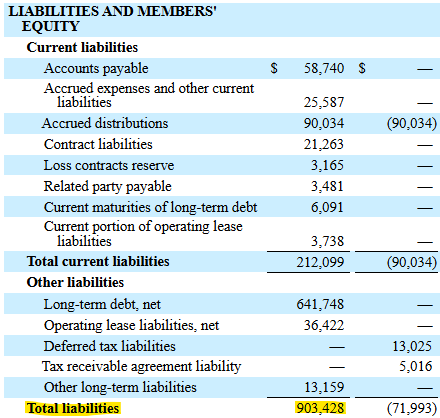
As of June 30th, the company owed $650 million on its term loan at 8.7% interest
IPO proceeds paid down around $170 million of that
On October 9th, it refinanced into a new $650 million facility: a $250 million term loan plus a $400 million revolving credit line, maturing in 2031
Cash as of June 30th was only about $28 million
With most of the IPO proceeds going to selling shareholders and debt paydown, the liquidity picture isn’t great.
Catalysts
New product launches across power, modular systems, and cooling, planned for late 2026 through mid-2027
More details on the third Ohio facility planned for next year
A hyperscaler formally standardizing on SkyBridge, which would be a massive win, though it’s a risky bet until it actually happens
Final Thoughts
Accelevation is posting incredible growth with a sizable $1.1 billion backlog. But I’d want the company to prove out its business model before taking the risk.
I’d like to see margins improve and profitability hold up for at least a couple of quarters, because the liquidity situation looks a bit bleak. Private equity control is also a concern.
For now, it’s an interesting company, but it stays on the watchlist. I may revisit it in a separate video.
Disclaimer
This content is for informational purposes only. You should not construe any such information or other material as legal, tax, investment, financial, or other advice. Nothing contained in this video constitutes a solicitation, recommendation, endorsement, or offer by Investing Review to buy or sell any securities or other financial instruments in any jurisdiction.
All content in this video is information of a general nature and does not address the circumstances of any particular individual or entity. You alone assume the sole responsibility of evaluating the merits and risks associated with the use of any information or other content in this video before making any decisions based on such information.