
Planet Labs PL 0.00%↑ , has a $4.9 billion market cap. The stock peaked at $51 back in May and now sits around $13.50, down more than 70%.
Meanwhile, revenue grew 58% last quarter.
So either the market got this wrong, or there was a lot of hype priced into the stock. Let’s find out…
What Planet Does
Planet photographs Earth’s entire landmass every single day. It does this with a fleet of 100+ small, cheap satellites called SuperDoves.
On top of that, Planet runs:
Higher-resolution satellites
A hyperspectral satellite line for methane detection
A software platform that turns all that imagery into usable data
A Public Benefit Corporation
Planet went public through a SPAC in December 2021, and it’s structured a bit differently: it’s a public benefit corporation (PBC).
Unlike a nonprofit, a PBC makes money and can distribute profits to shareholders. But it’s legally required to balance financial returns with a material positive impact on society or the environment. Planet does that by providing data for climate, deforestation, and methane monitoring.
The Business Model
Planet’s business falls into three customer groups. In the quarter ending July 31, 2026, total revenue was $116 million:

Defense is the main growth engine. Commercial is growing more slowly, and civil government is roughly flat.
Geographically, Planet has a big presence in Europe:
EMEA revenue grew 130%+ year over year, thanks to German and Swedish contracts
North America grew 25%
From Subscriptions to Satellite Sales
Historically, this has been a subscription business. 98% of annual contract value was recurring, and net dollar retention sat at 109%, meaning existing customers are expanding modestly.
But the model is shifting. Planet now has a second line called Satellite Services, where it builds satellites for governments and either sells them outright or sells dedicated capacity on them. That will make revenue lumpier.
Point-in-time revenue, recognized when a satellite is handed over, was 12% of Q2 revenue, up from just 1% a year ago. So satellite sales are growing.
Capital Intensity
Like most space businesses, Planet is capital heavy, and getting heavier. It plans $100 to $115 million in capex this fiscal year for manufacturing and new satellite fleets, roughly 25% of revenue.
Satellites wear out and need replacing, so a good chunk of that spending will be recurring.
Products
Planet’s daily global scan is genuinely differentiated. No other company does that right now.
High-resolution imagery is more competitive. Established vendors include Vantor (formerly Maxar), a company I invested in years ago before it was bought out, and Airbus.
Owl: The Next Big Thing
Planet’s next-generation monitoring satellite is called Owl. It offers one-meter resolution, which customers have been asking for to spot smaller objects like fishing vessels and individual vehicles.
Management says Owl delivers 10 times more data, 10 times faster, and gives Planet room to raise prices. However, there’s no deployment timeline yet.
Growth Opportunities
Sovereign Satellite Services
This is the biggest opportunity. Governments, especially in Europe, want their own reconnaissance satellites without spending a decade building them, and Planet can deliver. Recent examples:
Japan: JSAT spent $230 million in January 2025 to build and operate 10 Pelican satellites
Germany: Spent €240 million in June 2025 for dedicated capacity on those same satellites
Sweden: Launched its first sovereign reconnaissance satellite just four months after signing up
German civil government: A new contract worth up to €25 million
Management says the pipeline is healthy at $4 billion+, with $1 billion considered near term.
Even if Planet converts just a quarter of that near-term chunk over the next several years, that’s $250 million in new contracts, more than half of this year’s revenue.
AI-Driven Monitoring
Planet and SynMax provide AI-enabled maritime monitoring to the NGA across the Asia-Pacific
Planet recently landed its first AI hyperscaler customer, for data center monitoring
Industry Outlook
Commercial Earth observation is estimated at $5.1 billion in 2026, growing 9% a year to $11.4 billion by 2035
Estimates for satellite imagery specifically run closer to 14% annual growth
Either way, that’s much slower than Planet’s own growth. That tells you Planet is taking market share and tapping defense budgets that don’t show up clearly in these estimates.
Several growth drivers are in play:
AI: Automated detection and alerts across various industries
European defense: European militaries saw how dependent Ukraine was on US commercial providers like Starlink and Starshield, and they want their own capabilities
Competition
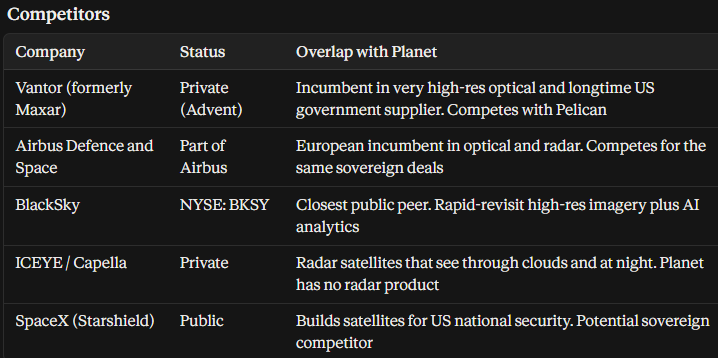
BlackSky is the only clean public comparison. It did $33 million in Q2 2026 revenue, up 50%, with around a $20 million net loss.
Planet’s quarterly revenue is about three times larger, it’s growing faster, and its net loss is less than half the size. That makes Planet one of the larger public pure plays in the space.
Key Partnerships
Planet partners with governments including Japan (via JSAT), Germany, Sweden, and NATO, and these are real revenue drivers.
The flashier partnership is Google. Planet is building prototype satellites for Google’s Project Suncatcher, which is testing whether AI compute can run in orbit. The first demo satellite launched October 1, with two more targeted for early 2027.
For now, it’s an R&D partnership with no booked revenue, but it’s worth watching.
The Moat
Planet’s main differentiator is its daily scan and image archive, but that’s a fairly minimal moat. Other companies could eventually do the same.
There are some advantages:
Switching costs: Analysts build workflows around Planet’s data specifically
Sovereign contracts: Depending on contract length, locking these in early is an advantage
But nothing in particular stops other companies from taking Planet’s business.
Dilution
Dilution is still a concern, since the company remains unprofitable:
Options and RSUs alone are around 10% of the current share count
Adding convertible notes brings potential dilution to around 20%
A $1.5 billion at-the-market (ATM) equity program announced in June is the bigger issue. Planet used $120 million of it in Q2, and it’s a serious overhang as long as the company is unprofitable.
The share count grew about 18% over the past year, from 308 million to 364 million. That’s not an insane level of dilution, but it’s an issue if you don’t like buying unprofitable companies.
Financials
Q2 results:
Revenue: $116 million, up 58%, beating the $104 million analyst consensus
Gross margin: around 57%, high enough to make the company interesting
Net loss: $9.4 million, down from $22 million a year ago
Adjusted EBITDA: around $14 million, up from $6.4 million
This was Planet’s first quarter of adjusted profitability as a public company. Granted, the satellite handover to Sweden pulled revenue from Q3 into Q2.
Quarterly revenue over the last four quarters went from $81 million to $87 million, then $94 million, and now $116 million. There’s clear acceleration in the business.
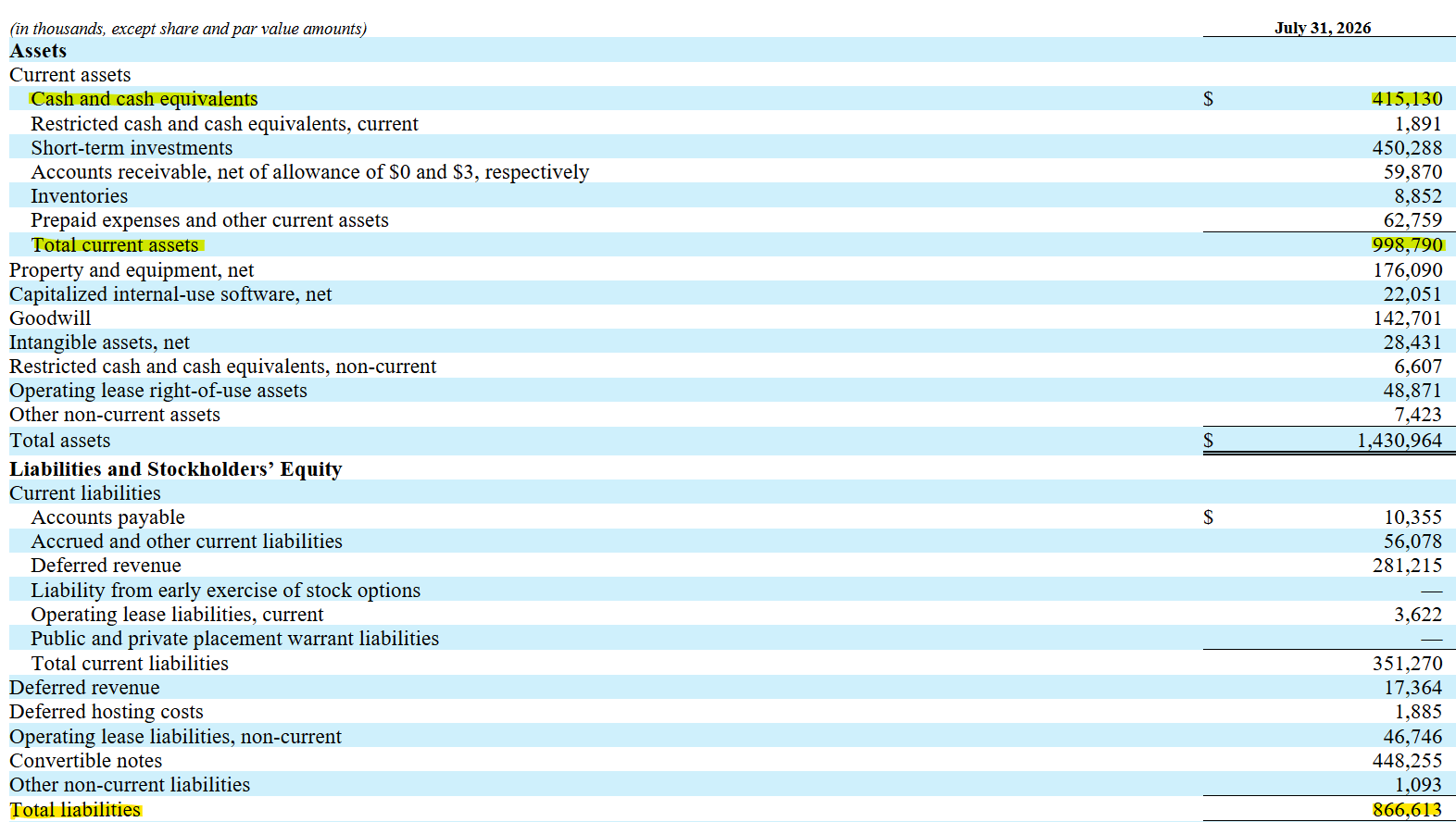
Balance sheet:
Cash and short-term investments: $865 million
Debt: around $450 million
Capital leases: $50 million
Net cash: around $400 million
The challenge is converting that $4 billion pipeline. Planet only netted $25 million in new contracts this quarter, which is weak. We’ll see if conversion picks up in future quarters.
Valuation
Full-year revenue estimates are around $430 to $441 million, or 40% to 43% growth.
At roughly a $4.5 billion enterprise value, that’s about 10 times sales. That’s a lot cheaper than the 32 times it traded at in June, but still not cheap for a company losing money.
Another issue is that SpaceX is such a massive supplier and competitor that a lot of money has rotated out of smaller space names and into SpaceX. Whether that continues, I don’t know, but it’s starting to create buying opportunities in some of these companies.
Planet has solid growth prospects, but we want to buy them at a reasonable price. That’s one of the most important parts of investing.
Catalysts
Q3 earnings, expected around December 3: Watch bookings, backlog, profitability, and revenue growth
Sovereign deals: Closing deals from the $1 billion near-term pipeline would be a boon, and one big European award could flip sentiment quickly
Owl: An actual deployment timeline would help
Final Thoughts
Planet is a much better business than it was 18 months ago:
40%+ revenue growth
Positive adjusted EBITDA and close to breakeven overall
Around $400 million in net cash
I do have some gripes:
Competition is a real issue, and there isn’t much of a moat
The company is still diluting shareholders
At 10 times sales, the stock is still pretty expensive, even after a 70%+ drawdown
So I’m going to wait for now, but it’s a stock I want to watch over the next year or so.
Disclaimer
This content is for informational purposes only. You should not construe any such information or other material as legal, tax, investment, financial, or other advice. Nothing contained in this video constitutes a solicitation, recommendation, endorsement, or offer by Investing Review to buy or sell any securities or other financial instruments in any jurisdiction.
All content in this video is information of a general nature and does not address the circumstances of any particular individual or entity. You alone assume the sole responsibility of evaluating the merits and risks associated with the use of any information or other content in this video before making any decisions based on such information.