
SB Energy, the data center developer, has filed to go public on the Nasdaq at a target valuation of around $50 billion. The company wants to raise $5 to $7 billion.
The roadshow was supposed to launch the week of September 21, and that didn’t happen. According to The New York Times, bankers couldn’t find enough buyers at that valuation, so the offering has been pushed back to at least mid-to-late October.
Investors did express interest, just at a number far below $50 billion. Even so, SB Energy reportedly still plans to move forward with the IPO, despite other companies canceling their offerings recently.
Company Overview
SB Energy is a SoftBank subsidiary founded in 2019. It started out developing solar farms and battery storage projects, then pivoted to building gigawatt-scale AI data centers with their own power generation attached.
The catch: none of its data centers are operational yet.
What it does have is a contracted backlog of roughly $439 billion:
About $430 billion from data center leases
About $10 billion from power projects
The Business Model: Power First
The biggest bottleneck in building AI data centers right now is electricity. Chips and buildings can be bought, but power can take years to secure because US grid connection queues are badly backed up.
So SB Energy’s strategy starts with power:
Secure the power: Lock down land with a path to gigawatts of electricity, and build generation alongside it.
Build the shell: Construct the data center buildings, substations, and transmission.
Lease it out: Sign a single AI tenant to a long-term lease, typically 15 to 20 years. The tenant brings its own chips and servers.
From there, SB Energy collects rent and owns the site for decades. In that sense, the data center side is essentially a landlord business.
The Power Business Today
Since no data centers are running yet, most of SB Energy’s current revenue comes from power. It builds, owns, and operates utility-scale solar and battery storage, mostly in Texas, and sells the electricity under long-term contracts.
As of June 30, the portfolio included:
2.2 GW of solar and storage in operation
2.5 GW under construction
Nearly 1 GW contracted
Roughly 5.5 GW in total
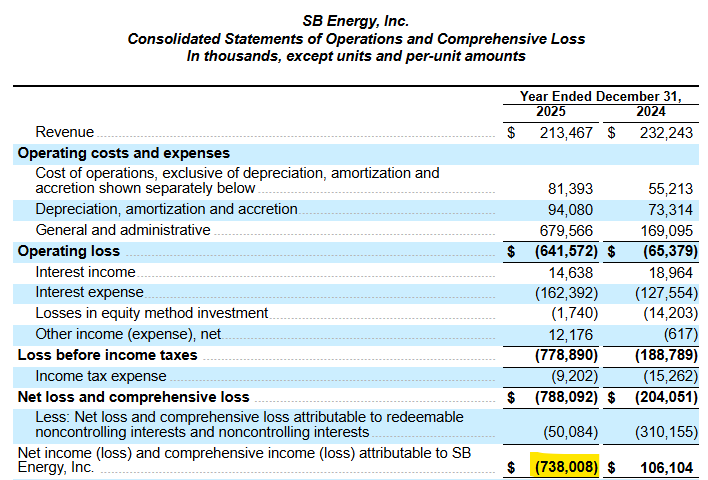
Growth here has been shaky. Revenue fell from $232 million in 2024 to $213 million in 2025, a decline of about 8%.
Both businesses are extremely capital intensive. Like any power producer, SB Energy faces enormous upfront cash burn, followed by decades of contracted cash flows if everything goes according to plan.
The Backlog Problem
That $439 billion backlog is heavily backloaded:
Only about $1 billion is expected to turn into revenue over the next two years
Roughly $360 billion sits beyond year eight
The first data center revenue is expected in Q4 2026, from a small 50-megawatt building leased to SoftBank.
Customer Concentration
The customer list is very short. All 8.8 GW of signed data center leases sit with two customers:
SoftBank, SB Energy’s own parent company
OpenAI, tied to roughly 97% of the backlog across two campuses
Having OpenAI as your anchor tenant isn’t the worst position to be in, but it’s a real concentration risk.
The Project Pipeline
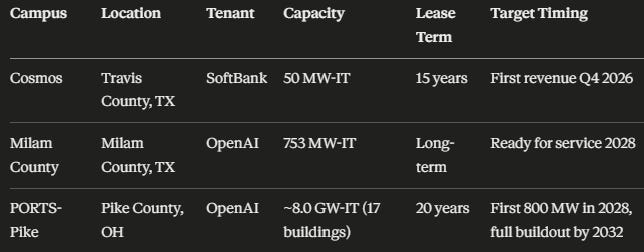
Cosmos: The smallest project and the only one close to delivering. It’s the 50 MW building leased to SoftBank, worth roughly $2.5 billion in contracted rent over 15 years.
Milam County: Currently under construction. It’s part of Stargate, the $500 billion AI infrastructure initiative announced by OpenAI, Oracle, and SoftBank alongside the US government in January 2025.
Ports Pike: This is the entire investment thesis, accounting for roughly 90% of SB Energy’s contracted data center capacity.
Ports Pike is being built on and around the former Portsmouth Gaseous Diffusion Plant in Ohio, a Cold War-era uranium enrichment site owned by the Department of Energy. It will exclusively host Nvidia hardware, with OpenAI as the tenant.
The site will need around 10 GW of power, and SB Energy plans to build a roughly $33 billion power plant to serve it. For reference, the entire US has only about 4 GW of installed geothermal capacity, and this one campus needs more than double that.
Key Partners
OpenAI: A tenant across several facilities. It invested $500 million in SB Energy in January 2026 and holds a board seat as long as it owns more than 5% of the company.
Nvidia: Committed $1.5 billion in a private placement at the IPO price, plus $1.5 billion in prepaid forward contracts that let it buy shares at 90% of the IPO price. That’s a potential $3 billion investment.
SoftBank: The parent company and controlling shareholder. It’s the tenant at the Cosmos campus and collects a trademark royalty equal to 1% of SB Energy’s gross profits.
Big names like these are a real form of validation. They signal confidence that SB Energy can actually build these data centers and fill them with strong tenants, even if it adds to the concentration risk.
Industry Tailwinds
The tailwind here is undeniable. AI is set to keep growing for the foreseeable future, and McKinsey estimates AI will require $5.2 trillion in data center investment by 2030.
Power has become the main constraint. That’s why nearly every serious data center developer now builds its own on-site generation, or brings in a partner to do it, rather than waiting years for a grid connection.
The space is attracting enormous capital from hyperscalers, investment funds, sovereign wealth funds, and private credit, all competing for the same sites.
Competition
With this much growth, the data center space has plenty of competitors:
Crusoe: The closest comparison. It raised $3.9 billion at a $30.9 billion valuation on September 17. It has over 6 GW of contracted capacity and more than $140 billion in contracted revenue spread across Oracle, Microsoft, Meta, and Google. Its flagship 1.2 GW campus in Abilene, Texas, already has buildings running.
Vantage Data Centers: Another major developer, reportedly exploring an IPO or sale at around a $100 billion valuation. It also works with Oracle and OpenAI.
Fermi: Another pre-revenue, power-first data center developer in Texas with a massive pipeline.
So SB Energy has the bigger backlog on paper, but Crusoe has actual operating facilities and a more diversified customer base.
The Fermi Warning
Fermi is a comparison every investor should look at. It went public in October 2025 at roughly a $15 billion valuation and hit $19 billion on its first day of trading.
As of September 18, Fermi’s market cap had collapsed to around $3 billion, down more than 80% from its peak in less than a year. The market is ready to punish these companies when timelines slip.
On the power side, SB Energy also competes with established players like NextEra, Clearway, and AES for grid connections and equipment.
No Real Moat
SB Energy has some of the best partners in the space, but it’s essentially concentrated on one customer, and there’s no real moat. Plenty of companies are building data centers with power generation attached.
If you’re betting on this company, you’re most likely doing it because of the partners.
Financials
The IPO hasn’t happened yet, so details on the share structure and financials are still limited. Here’s what we know from the S-1.
The company isn’t generating sufficient cash flow and is currently cash-flow negative.
Full year 2025:
Revenue: $213 million
Net loss: $738 million
First half of 2026:
Net loss: $3.2 billion
That number looks catastrophic, but most of it is non-cash:
About $2.6 billion came from the rising value of OpenAI’s warrants in the company
About $600 million was stock-based compensation
Strip those out, and the actual operating loss was around $552 million for the half. The warrant accounting will keep the reported numbers messy going forward.
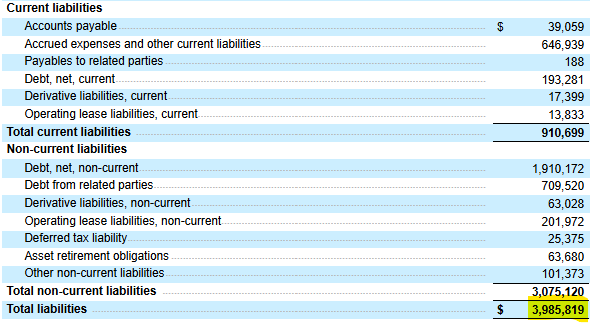
Total debt is around $4 billion. That includes roughly $1 billion of notes at an 8.8% interest rate due 2031, which funded the Cosmos project. A rate that close to 9% tells you lenders are pricing in some real risk.
Valuation
A $50 billion market cap against less than $300 million in trailing 12-month revenue works out to around 186 times sales. That’s for a company whose data center business doesn’t exist yet.
The $5 to $7 billion raise will cover the company for a while. But SB Energy will likely lose money for years, and Ports Pike alone will require tens of billions in construction spending. Expect more debt and more equity raises down the road.
Catalysts
Positive:
The IPO itself, and how the stock trades in its first few weeks
The Cosmos campus delivering SB Energy’s first-ever data center revenue in Q4 2026, proving the company can actually build these
Additional deals with Nvidia, other hyperscalers, or new tenants
Negative:
Any bad news on OpenAI’s funding or projects
Construction delays or slipping timelines, which could absolutely demolish the stock
Final Thoughts
Buying SB Energy right out of the IPO looks pretty risky. You’re paying $50 billion for no proven projects, and it’s easy to see how the stock could collapse if anything goes wrong.
In a way, this is really an investment in OpenAI, given how much exposure SB Energy has to its projects, and that comes with its own set of risks.
I’m not opposed to pre-revenue companies. I’ve covered plenty of them. But this price tag is too high right now. If the stock drops dramatically after the IPO, it could be worth another look.
Disclaimer
This content is for informational purposes only. You should not construe any such information or other material as legal, tax, investment, financial, or other advice. Nothing contained in this video constitutes a solicitation, recommendation, endorsement, or offer by Investing Review to buy or sell any securities or other financial instruments in any jurisdiction.
All content in this video is information of a general nature and does not address the circumstances of any particular individual or entity. You alone assume the sole responsibility of evaluating the merits and risks associated with the use of any information or other content in this video before making any decisions based on such information.