
Archer Aviation ACHR 0.00%↑ , has a market cap of $3 billion after the stock crashed more than 65% over the past year.
Archer develops electric air taxis, also known as eVTOLs. Think of a helicopter for transportation, but built for mass scale, since these vehicles don’t create the same noise and disruption that helicopters do.
The goal is to fight urban congestion by turning an hour-long drive into a 10 to 20-minute flight.
Over the last 18 months, Archer has stretched that pitch quite a bit. It now calls itself an end-to-end aerospace platform covering:
Air taxis
Military drones
Aviation AI
It sells to both commercial and defense customers.
So is the stock trading at a discount right before commercialization, or is the collapse justified? Let’s start with the fundamentals.
How the eVTOL Industry Works
The industry has several layers, and each one makes money differently:
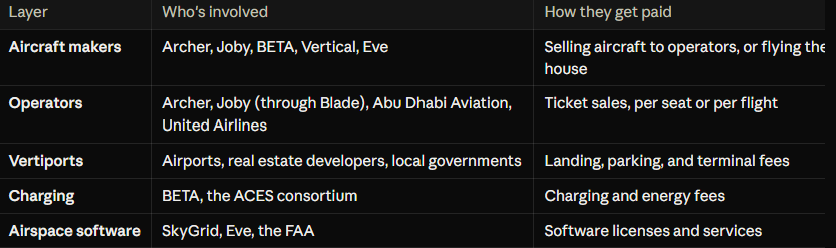
Archer Wants to Play in Almost Every Layer
It plans to sell Midnight, its main aircraft, to operators abroad, reportedly for around $5 million each
It plans to run its own airline in US cities
It now owns an airport
Once the Boeing deal closes, it will own airspace software too
The Unit Economics
These aircraft may eventually be autonomous, but for now, every one needs a pilot on board. Under FAA rules, each pilot needs a type rating for the specific aircraft they fly.
Here’s a rough idea of the math. Say a ticket costs $100. If an aircraft flies 10 trips a day with all four seats filled, that’s $4,000 a day, or about $1.5 million a year per aircraft.
That’s before pilot salaries, electricity, maintenance, insurance, and other costs.
Why eVTOLs Instead of Helicopters?
Noise
Helicopters are extremely loud, which is why cities restrict where they can fly. Archer says Midnight produces about 45 decibels in forward flight and claims it’s roughly 1,000 times quieter than a conventional helicopter. If that holds up, it opens routes and landing sites helicopters could never get approved for.
Cost
Helicopter rides run roughly $10 per passenger mile
Archer expects early Midnight fares around $4 to $5 per passenger mile, with a long-term goal of $1
The stated target is roughly the cost of Uber Black
For comparison, Blade’s helicopter transfers between Manhattan and Newark Airport cost around $159 per seat.
Safety and Maintenance
eVTOLs are likely safer, too. Electric aircraft have far fewer moving parts than a helicopter’s engine and gearbox, which means less maintenance and more time in the air.
They also have built-in redundancy. Midnight uses 12 motors and six independent battery packs, so no single engine or rotor failure can bring the aircraft down. That’s a failure we see with helicopters on a semi-regular basis.
Time
Archer’s Salinas to Monterey flight took about nine minutes each way, versus 35+ minutes by car
A trip from downtown Manhattan to Newark Airport could take around 10 minutes
Emissions and Infrastructure
Because they’re electric, eVTOLs have zero operating emissions and burn no jet fuel, which also lowers costs.
They don’t need runways, either. Vertiports can go on rooftops, parking structures, or existing airport space, which opens up more options.
Keep in mind, a lot of these benefits are still hypothetical, because most companies haven’t deployed these vehicles at scale yet.
The Certification Process
A big reason for that is certification. In the US, an eVTOL company needs several separate FAA approvals:
Type certificate: Approves the aircraft’s design
Production certificate: Approves the factory and the quality systems that build the aircraft
Part 135 air carrier certificate: Allows the company to operate commercial flights
Part 145: Allows the company to maintain and repair aircraft
On top of that, every pilot needs a rating for the specific aircraft. You can’t just take someone who flies a 737 and put them in an eVTOL.
The Type Certificate: Four Phases
The type certificate is the hardest part, and Archer describes it as a four-phase process:
Certification basis: The FAA and the company agree on the rules and airworthiness criteria the aircraft must meet.
Means of compliance: They agree on how each rule will be proven, whether by test, analysis, or inspection.
Certification plans: The FAA approves the plans.
Implementation: The hardest part. The company builds the aircraft and runs for-credit tests that count toward certification, including a required number of flight hours before commercial use.
Because the FAA is so strict, many regulators around the world validate FAA approvals rather than starting from scratch. Once Archer has FAA certification, getting approved in other jurisdictions may not take much extra work.
Where Archer Stands
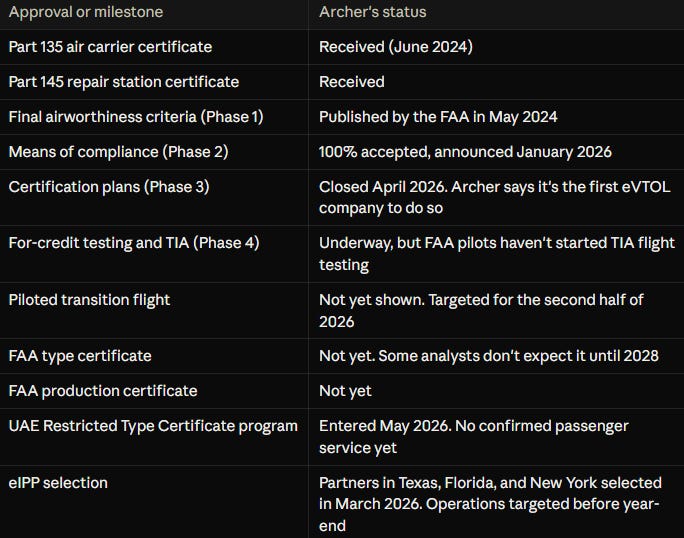
Archer has a variety of certifications in hand but is still in phase four. Analysts estimate that could take another couple of years, with completion possibly in 2028.
Phase four is the longest and most expensive part of the process, so the timeline isn’t surprising. But it means Archer may still be a few years away from real commercial flights.
Archer’s Business Today
Without certification, Archer isn’t making much revenue:
Q2 2026: $5 million
Q1 2026: $1.5 million
A year ago: zero
Most of that revenue comes from Hawthorne Airport in Los Angeles, which Archer agreed to buy for $126 million as a future air taxi hub. For now, the revenue comes from ordinary airport operations like fuel sales and hangar leasing.
Archer is also collecting initial Launch Edition payments from Abu Dhabi Aviation, its first international customer.
Capital Intensity
This is a capital-intensive business. Archer is paying for:
A manufacturing plant in Covington, Georgia
Airports and vertiports
Test aircraft
A brand-new hybrid aircraft platform
Capex in Q2 alone was $37 million.
Recurring revenue from airline operations and software may come eventually, but that’s years away. For now, most revenue will likely be transactional or lumpy and program-based, from aircraft sales or defense contracts.
Products/Boeing Deal
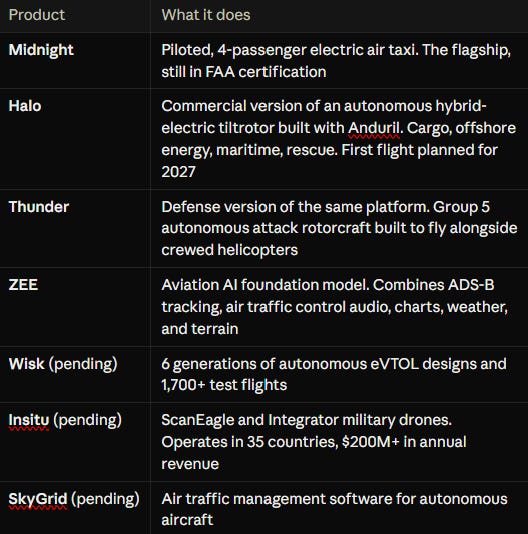
Archer’s lineup now includes aircraft, drones, and AI aviation software, including several products coming from Boeing.
On August 10th, Archer agreed to buy three Boeing subsidiaries in an all-stock deal:
Wisk: An autonomous eVTOL developer
Insitu: A military drone maker
SkyGrid: Air traffic management software
In exchange, Boeing gets:
Warrants
A board seat
New Archer shares equal to 16.5% of the company
Continued access to Wisk’s autonomous flight technology for its own aircraft
Boeing also committed up to $55 million to Archer’s next funding round, so you can assume more dilution is coming.
The best pickup is Insitu. It’s already a profitable military drone business bringing in more than $200 million a year, about 10 times Archer’s current annualized revenue.
Industry Outlook
Archer now operates in three industries: air taxis, military drones, and software. Growth estimates vary, but all three are likely to grow significantly.
Air taxis are a brand-new industry, though, so they’re a speculative bet. The space is also consolidating fast:
Lilium and Volocopter both went through insolvency, and Archer bought Lilium’s patents
Joby bought Blade
Archer is buying Wisk
The field is shrinking to a handful of companies with enough cash to survive, and it may narrow even further.
Competition
Archer’s top five public competitors:
Joby Aviation
Beta Technologies
Vertical Aerospace
Eve Air Mobility
AeroVironment
There are also competitors in China, like EHang.
Notably, Archer is behind some of these companies. Joby, Beta, and Vertical have all flown piloted aircraft that lift off vertically. Archer hasn’t done that yet.
Thanks to its deals and its own development, Archer is ahead in defense and more diversified than its peers. But it’s behind on certification.
This is a growing industry in its infancy, with many jurisdictions to operate in. So another company reaching market first doesn’t mean Archer is done for, but it’s obviously not ideal. We’ll have to see how quickly Archer catches up.
Key Partners
Boeing: Holds equity and is committed to the next funding round
Stellantis: A contract manufacturing partner and one of Archer’s largest shareholders at 13%
Anduril: Co-developer of Archer’s defense platforms and its main entry point into defense
Abu Dhabi Aviation and the Abu Dhabi Investment Office: One of Archer’s first paying international customers
United Airlines: An early investor, though there’s been no recent news there
Much of the hype around Archer probably comes from these big names.
The Moat
Those partners are great to have, but beyond them, Archer doesn’t really have a moat. There are plenty of competitors in the US and China, and I wouldn’t call the business differentiated. It’s not going to have unique pricing power.
But this industry will be so expensive to build that it will likely end up like ride-hailing and many other industries: an oligopoly of a few large players, with everyone else going bankrupt or fighting for scraps.
At this point, Archer still looks like it could be one of the winners. But that depends on how much money it can raise and how long it keeps diluting, because it’s still burning large amounts of cash every quarter.
Financials
Q2 2026:
Revenue: $5 million
Operating expenses: up 61% year over year, driven by $186 million in R&D and $94 million in G&A
Operating loss: about $279 million
Net loss: $263 million
As expected, with commercialization still a couple of years out, revenue is minimal.
Balance sheet:
Cash and short-term investments: about $1.5 billion
Debt: about $78 million, plus $45 million in leases
Total liabilities: about $300 million against $2.2 billion in assets
I like that Archer carries very little debt, but it’s burning through a lot of cash. Quarterly cash burn is up 53% over three quarters. At the current pace, Archer has about eight quarters of runway before Insitu’s cash flow kicks in, or it has to raise again.
Valuation
At a $3 billion market cap, subtracting $1.5 billion in cash and adding back debt gives an enterprise value of about $1.5 billion.
Archer is paying 152 million shares for the three Boeing subsidiaries, worth around $600 million at today’s price. In early 2025, Jefferies estimated that Insitu alone could sell for about $500 million.
So the cash plus Insitu’s standalone value comes to about $2 billion. That means the market is putting only about $1 billion on everything else, including the entire eVTOL business.
If Archer succeeds, the price is starting to look attractive, but it’s still very risky.
Risks
Certification delays: Archer’s track record on timelines hasn’t been great, which is common for companies trying to commercialize new technology.
Dilution: Pretty much guaranteed.
Doing too much at once: Certifying and building multiple aircraft, developing software, running an airport, and absorbing several Boeing businesses could get overwhelming.
Litigation: Archer sued Vertical in February in the Eastern District of Texas, and Vertical countersued, claiming Midnight infringes one of its patents. I have no idea who’s in the right.
Competition: Some competitors are ahead on certification, and the longer Archer takes to catch up, the more that could hurt.
Catalysts
Midnight’s first piloted transition flight, targeted for the second half of 2026
Further operational testing with the government in Texas, Florida, and New York
New commercial partner announcements
Testing in places like Abu Dhabi
Final Thoughts
Archer is in an interesting position. Through acquisitions and development, it has pivoted more toward drones and defense, and the air taxi story has become more of an upside option.
I haven’t decided whether that’s bullish or bearish. It’s probably bullish for limiting dilution, since defense revenue can help fund the business. But it could hurt Archer in air taxis, which could be an insane area of growth.
I’ll probably decide how I feel after researching Joby and the other companies in the space, and my next video will likely be on Joby.
So I’m not making a call on Archer yet. But after the stock’s decline, it’s starting to get more interesting, at least from a price perspective.
Disclaimer
This content is for informational purposes only. You should not construe any such information or other material as legal, tax, investment, financial, or other advice. Nothing contained in this video constitutes a solicitation, recommendation, endorsement, or offer by Investing Review to buy or sell any securities or other financial instruments in any jurisdiction.
All content in this video is information of a general nature and does not address the circumstances of any particular individual or entity. You alone assume the sole responsibility of evaluating the merits and risks associated with the use of any information or other content in this video before making any decisions based on such information.