
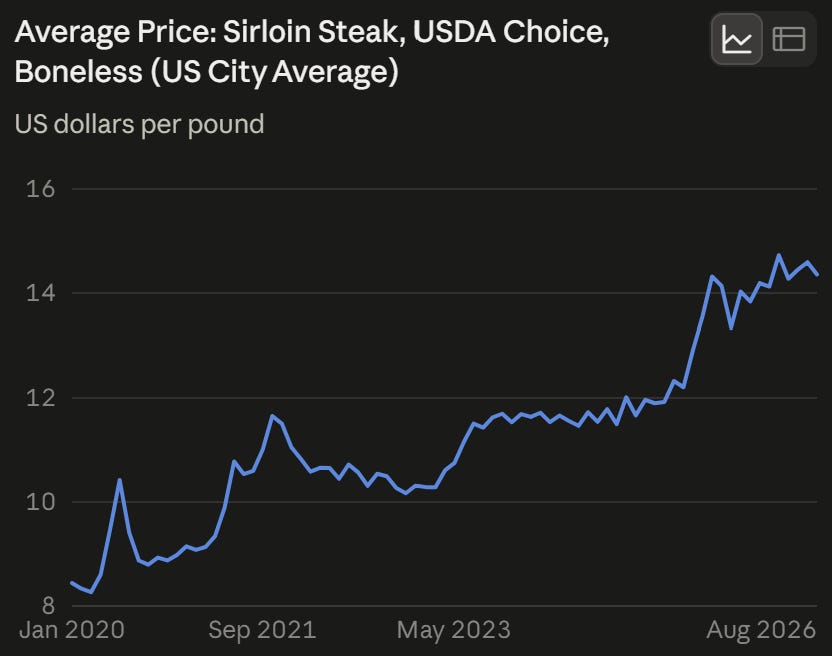
The average price of a sirloin steak in the United States has gone from $8.95 per pound in 2020, to $14.32 per pound in 2026. The price is skyrocketing… with a big spike in 2025. This is across the board for all beef products.
The United States is undergoing a serious beef supply contraction. According to the USDA, as of January 1st, the total U.S. cattle inventory stood at 86 million, the smallest national herd since 1951.
Total inventory has stabilized since the summer, but issues persist. The 2026 calf crop is projected at 32.5 million head, a ninth consecutive annual decline.
So, why is this happening? Historical droughts, rising costs, and the screwworm cases breaking out in Texas and New Mexico…
Historical Droughts
To be fair, this is a part of a normal cattle cycle of roughly ten-year expansions and contractions in the U.S. herd. The current contraction was triggered by the 2020 through 2022 drought, which was severe enough across the southern Plains and Mountain West that ranchers could not grow or afford enough food for their animals.
When grass runs out and hay has to be trucked in from three states away, most ranchers just opt to sell their cows.
The problem is, replacing that sold cow later on… takes at least 3-4 years for another calf to be born and grow up in a feedlot before it eventually ends up as meat in a grocery store.
This lag is why the shortage has not produced a supply response yet. 2025 was one of the most profitable years on record for cattle operators.
Three things are making it troublesome to increase herd numbers.
First, the drought is still ongoing. More than 70% of the total beef cow herd sat in drought-affected territory, compared with a typical average closer to 20%.
The second is capital. Bred heifers now cost $4,000 to $5,000 a head. Financing is harder to acquire with higher interest rates than what we saw before 2020.
And the third is import disruptions. The emergence of the New World screwworm, a flesh-eating parasite that can kill a full-grown cow in one to two weeks, has been a terrifying hindrance. It originated in Mexico and Central America back in 2024.
The U.S. closed the southern border to Mexican cattle in November 2024, and it was closed through most of 2025 and the first half of 2026. That removed roughly 1.2 million Mexican feeder cattle per year. The USDA recently reopened the Douglas, Arizona port, and the New Mexico ports at Santa Teresa and Columbus remain closed. But the government plans to open the Santa Teresa port soon.
With supply struggling to catch up, U.S. demand for beef has actually continued to grow. This has further contributed to price increases as well.
The Economic Damage
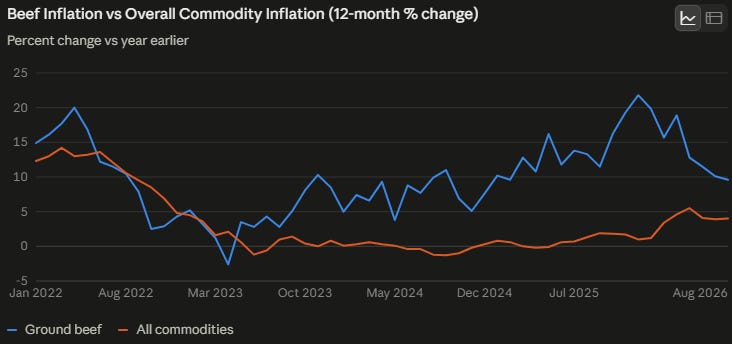
Beef price inflation running near 10% against overall commodity inflation near 3% hurts consumer pocketbooks. Substitution toward chicken and pork has occurred at the margin but far less than a textbook would predict.
Restaurants are absorbing a margin shock. Texas Roadhouse, where beef makes up more than half its sales, reported 9.5% commodity inflation in the fourth quarter of 2025. It guided to roughly 7% inflation for 2026 and raised menu prices 1.9% in April.
While the consumer and packing plants lose… cow ranchers win. As cow prices rise, their returns have been at or near record levels.
What Washington Is Doing About It
Washington is trying a variety of options to bring beef prices down.
In February, the Trump administration lowered tariff rates on lean beef trimmings from Argentina, adding 80,000 metric tons of ground beef supply.
In August, they waived tariffs on an additional 300,000 metric tons of ground beef for ninety days, with the imported product to be sold at a discount to market. That supply is coming from Brazil and Argentina.
The admin is also creating favorable legislation for ranchers. This includes creating a new insurance program that would let producers insure the economic value of holding a heifer back for breeding over a two-year window rather than selling her for slaughter.
The USDA announced a program with up to $500 million in funding for independent and regional slaughter facilities, as well as a $500 million fertilizer onshoring program aimed at input costs.
Running alongside all of those efforts is the screwworm eradication campaign…
USDA is building a sterile fly production facility at Moore Air Base in Texas, designed to produce up to 300 million sterile flies per week. When the female flies mate with these sterile males, no babies.
The USDA also committed $25 million in July toward a sterile fly dispersal facility in Arizona. That infrastructure is what allowed the Douglas, Arizona port to reopen for Mexican cattle.
Investment Options
When thinking about investment options… considering all of the government action taking place… we could start to see beef prices at least stabilize. So, it might be past the time to try to invest in cow ranchers or live cattle futures. And there are no public cow ranchers anyway.
You can buy CME live cattle and feeder cattle futures, which track the commodity prices themselves. But this requires a good understanding of futures contracts and institutional access. Retail-accessible proxies include the iPath Series B Bloomberg Livestock ETN (COW), which blends live cattle with lean hogs. So, you do have some options if you think cattle prices will continue to rise.
If beef prices start to fall back down, the main investment option would be beef processors. Packers and processors are generally cyclical, and higher margins for these companies from lower prices would boost their stock prices. Tyson Foods (TSN), JBS, Marfrig (MBRFY), the owner of National Beef, and Minerva (MRVSY) are different public meat processors.
If you like to short, you can look to short restaurants like steakhouses that are buying beef heavily and feeling the pain from higher prices.
As always, I am not endorsing any of these options, and your investment decisions are yours to make.
News Events to Watch
Potential news catalysts to watch:
The January 2027 USDA Cattle Inventory report - if the cow herd stabilizes, that confirms the cycle has turned and starts the clock on a three-to-four-year supply recovery.
Watch the drought monitor through fall and winter, because without forage there is no potential to rebuild food supplies (grass) for the cows.
Watch whether the tariff-free import programs get extended or not, because each extension pressures domestic cattle prices further.
And keep in mind, the U.S. government has an ongoing DOJ investigation into the top four meat processors in an antitrust suit to ensure they are not colluding.
In all likelihood, beef supply will be tight through the next few years. But we will need to see how new legislation plays out. Thanks for watching.
Disclaimer
This content is for informational purposes only. You should not construe any such information or other material as legal, tax, investment, financial, or other advice. Nothing contained in this video constitutes a solicitation, recommendation, endorsement, or offer by Investing Review to buy or sell any securities or other financial instruments in any jurisdiction.
All content in this video is information of a general nature and does not address the circumstances of any particular individual or entity. You alone assume the sole responsibility of evaluating the merits and risks associated with the use of any information or other content in this video before making any decisions based on such information.