
GE Vernova GEV 0.00%↑ , was spun out of General Electric in April 2024. Since then, the stock has had a monster run, up 766%, and the company now sits at a $265 billion market cap.
GE Vernova builds the equipment that makes electricity and moves it:
Gas turbines
Steam turbines
Nuclear reactors
Wind turbines
Transformers
If you want to own the global power build-out, this is one of the cleanest ways to do it.
Demand is massive. In Q2 2026, orders jumped 88% organically to $24 billion. The backlog hit $173 billion, up roughly $50 billion from a year ago, and management expects it to reach $200 billion in 2027.
The Three Segments

GE Vernova reports its business in three segments: Power, Electrification, and Wind.
Power
Power is the largest segment, covering gas, steam, nuclear, and hydro. Segment margins are sitting around 19%.
Electrification
Electrification is the fastest grower, though some of that growth is bought. GE Vernova picked up the remaining 50% of Prolec GE, the transformer maker, for $5.3 billion.
Strip that out, and Electrification still grew 29% organically. Segment earnings have more than doubled from $314 million a year ago.
Wind
Wind is shrinking. Orders fell 40%, the segment is losing money, and management expects around $400 million in wind losses for 2026.
The Business Model
This is a capital-heavy business. GE Vernova is building factories, foundries, test facilities. And R&D centers, and capex is guided up 30% this year.
Services help offset that. Every gas turbine GE Vernova installs comes with decades of maintenance, parts, and upgrades. Equipment sales are lumpy, but services bring in steady, recurring, higher-margin revenue.
Customers Are Paying Up Front
Customers are now paying deposits just to reserve future production slots. In Q1 alone, down payments and slot reservations delivered a $5.3 billion working capital benefit.
In practice, customers are funding GE Vernova’s growth in advance. That can also reverse if the cycle turns and growth drivers like AI take a nosedive. Plenty of people think we’re in an AI bubble, but we’ll see what happens.
Products
Gas Turbines
GE Vernova’s flagship product is the heavy-duty gas turbine, mainly the HA class. It also sells aeroderivative turbines, which are smaller, faster to deploy, and popular with data centers.
In Q2, GE Vernova booked:
52 heavy-duty units
61 aeroderivatives
The most important number for this business is gigawatts under contract:
Gas backlog: grew from 44 GW to 53 GW in Q2
Slot reservations: grew from 56 GW to 63 GW
Combined: 116 GW, with a target of at least 125 GW by year-end
Compare that to production capacity. GE Vernova expects to hit 20 GW of annual output in Q3 2026 and is working toward 30 GW by 2030.
Nuclear
On the nuclear side, the big development project is the BWRX-300 small modular reactor (SMR).
On September 29, the US Nuclear Regulatory Commission issued a construction permit for Clinch River Unit 1. That makes TVA the first US utility cleared to build a BWRX-300, and it’s only the second advanced reactor construction permit ever issued in the country.
Nuclear is strategically important, but financially it’s a small part of the business. TVA hasn’t set a construction date and is still negotiating cost-sharing with partners.
Electrification
Recent launches include a new circuit breaker and a medium-voltage power supply built for data centers, which starts shipping in mid-2027.
Industry Backdrop
GE Vernova sits across three industries: power generation, grid equipment, and wind. The backdrop is the strongest it’s been in decades.
Power demand: The IEA projects global power demand growing about 3.5% per year through 2030, more than twice the pace of the prior ten years.
Grid investment: The IEA says annual grid investment needs to rise roughly 50% by 2030, from about $400 billion today.
An Era of Scarcity
Large transformer lead times have more than doubled since 2019
US transformer prices are up 79%
Gas turbines are booked out for years
When equipment is this scarce, suppliers get to set the terms, and GE Vernova is reaping the rewards.
Competition

How differentiated GE Vernova is depends on the segment. In heavy gas turbines, there are really only three serious suppliers in the world. Grid equipment is more competitive.
That said, supply is so tight right now that delivery slots and manufacturing capacity matter more than who you’re competing against. There’s just that much demand.
China has had a huge impact on renewable energy markets, particularly solar and wind, by flooding them with supply. That’s hurting GE Vernova on the wind side, but the rest of the business is picking up the slack.
Key Partnerships
Hitachi is the most impactful partner:
GE Vernova’s nuclear business runs through a global alliance with Hitachi
Its fuel business, Global Nuclear Fuel, is a joint venture with Hitachi
The relationship is the foundation of the BWRX-300 SMR program
In March, the two companies agreed to explore SMR deployment in Southeast Asia
Other recent deals:
LS Electric: A joint venture called Grid X Technology, with GE Vernova providing the technology and LS Electric providing local manufacturing
Studsvik and Samsung C&T: A commitment to advance a 1.2 GW nuclear project in Sweden
Blue Energy: A collaboration in Texas on a gas-nuclear plant concept
The Moat
Patents: They offer some protection, but they aren’t that meaningful for an energy business.
Switching costs: Strong. Once a utility installs a GE turbine, it services that machine for 25+ years and won’t swap it out on a whim.
Scale and barriers to entry: Also strong. Building heavy gas turbines is incredibly difficult and capex intensive and takes decades of experience, which is why there are only three credible suppliers.
Regulatory relationships: Its relationship with the NRC helps on the nuclear side.
The exception is renewables. Wind turbines are increasingly commoditized, Chinese manufacturers are undercutting on price and supply, and GE Vernova is taking heavy losses on some offshore contracts.
Share Buybacks
GE Vernova bought back roughly 4.3 million shares for $3.6 billion in the first half of 2026.
That more than offsets dilution. In Q2, options and RSUs added around 2 to 3 million shares, about 1% of the 266 million shares outstanding as of June 30.
Financials
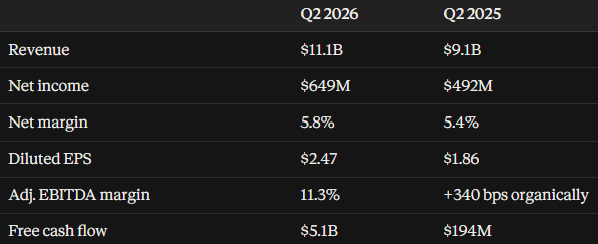
Q2 2026:
Revenue: roughly $11 billion, up 22% (12% organically)
Net income: about $650 million, a 5.8% net margin
Adjusted EBITDA margin: around 11%
As expected for this kind of business, margins are relatively low, but the company is solidly profitable and printing cash given all the demand.
Balance sheet:
Cash: $13.1 billion
Long-term debt: around $2.8 billion, mostly notes issued this year and due between 2031 and 2056
Net cash: around $10 billion
The trend over the last six to eight quarters is clearly positive: accelerating orders, expanding margins, and free cash flow climbing from roughly breakeven to $5 billion this quarter.
Risks
The cycle turning: Power equipment is one of the most cyclical industries out there, and GE’s own power business went through a brutal bust in 2017 and 2018. Today’s demand leans heavily on data centers and AI capex. If hyperscalers slow spending, slot reservations could be deferred or canceled, and those deposit-driven cash flows could reverse.
Execution: With five years of backlog and lumpy project cash flows, any manufacturing hiccups or supplier delays could hit contracts and revenue.
Wind: This segment is clearly a problem.
Tariffs: Expected to add $100 to $200 million in costs this year, even with contractual protections.
Valuation: At 60 times forward earnings, there’s no room for imperfection. We saw that this quarter: even with strong results, the stock fell roughly 10%.
Final Thoughts
GE Vernova is a high-quality business. It holds an oligopoly position in several industries, many of those industries are growing rapidly, and it has a large cash reserve to absorb headwinds.
The weak spot is wind, where Chinese competition is doing real damage. The valuation is also getting out of hand.
So it’s an expensive buy, but it’s not the worst way to play the data center demand story. Whether this is a bubble or not, I’m not going to try to call what the market does next.
Many analysts say data centers are the only thing propping up the US economy right now. Make of that what you will.
Disclaimer
This content is for informational purposes only. You should not construe any such information or other material as legal, tax, investment, financial, or other advice. Nothing contained in this video constitutes a solicitation, recommendation, endorsement, or offer by Investing Review to buy or sell any securities or other financial instruments in any jurisdiction.
All content in this video is information of a general nature and does not address the circumstances of any particular individual or entity. You alone assume the sole responsibility of evaluating the merits and risks associated with the use of any information or other content in this video before making any decisions based on such information.