
Uber has a market cap of roughly $143 billion, with the stock sitting around $67. That’s about 30% off its 52-week high of around $100.
Meanwhile, the business is putting up some of the best numbers in its history:
Q2 2026 gross bookings hit $58 billion
Trailing 12-month free cash flow crossed $10 billion for the first time
So why is the stock down? I think it mostly comes down to robotaxis. Investors are worried about how much competition from Waymo, Tesla, and others will hurt Uber’s business model.
Uber has reached enormous scale:
208 million average monthly active users in Q2 2026, up 16% year over year
3.9 billion trips in a single quarter
Operations in 70+ countries and roughly 15,000 cities
Outside of China, Uber has become the default app for mobility and delivery in a variety of jurisdictions…
The Business Model
Gross bookings are the total dollar value flowing through the app: everything riders pay drivers and everything eaters pay restaurants. Revenue is the slice Uber actually keeps.
In Q2:
Gross bookings: $58 billion, up 24%
Revenue: $14 billion, up 12%
That revenue growth looks weak on paper, but Uber changed its business model in the UK, where driver payments now get booked as a reduction of revenue. That alone knocked about 8 percentage points off revenue growth, so underlying activity is still growing around 20%.
Three Segments

Mobility is the main profit engine, but it’s also the part of the business most likely to be displaced by autonomous vehicles. Freight is the problem child and has been a drag on the company for years.
The business is extremely capital light. Uber spent just $135 million on capex in the first half of 2026, against $5.2 billion in operating cash flow.
Uber doesn’t own the vehicles. The drivers handle that, and Uber just has to run the app.
Most revenue is transactional, with a recurring layer from Uber One memberships and Uber for Business corporate accounts.
Acquisitions and Growth
Uber is driving growth through several acquisitions:
ezCater: In October, Uber agreed to buy ezCater for $2.3 billion in cash. It’s the largest corporate catering marketplace in the US, with more than $2.5 billion in gross bookings over the last 12 months.
Blacklane: In March, Uber agreed to buy this Berlin-based chauffeur service for $550 million.
Its own robotaxi: Uber is entering the robotaxi space with a platform built on the Lucid Gravity SUV and Nuro’s self-driving software, targeted to launch in the San Francisco Bay Area in late 2026.
The Big One: Delivery Hero
Uber offered around €41 per share in cash for Delivery Hero, roughly $15 billion, or about $13.7 billion adjusting for the stake Uber already owns.
To get ahead of antitrust issues, Delivery Hero is selling its businesses in 14 markets that overlap with Uber to SSW Partners for roughly €1.4 billion.
Uber will keep around 50 markets, adding about $42 billion in gross bookings. That includes brands like Talabat in the Middle East and Glovo across Southern Europe and Africa.
The combined company would:
Cover 99 markets
Generate about $236 billion in gross bookings
Offer both rides and delivery in 58 markets, up from 34
Uber is essentially buying an existing food delivery customer base, with the hope of selling those customers rides too.
Industry Trends
Autonomy: The obvious one. Companies like Waymo are scaling fast, and Uber has signed a range of autonomous vehicle partners onto its platform.
Consolidation: DoorDash bought Deliveroo, Prosus owns Just Eat Takeaway, and Uber is buying Delivery Hero. The market is consolidating around a few big winners.
Regulation: Jurisdictions are cracking down as they figure out how to classify gig workers and what benefits they should get.
Competition
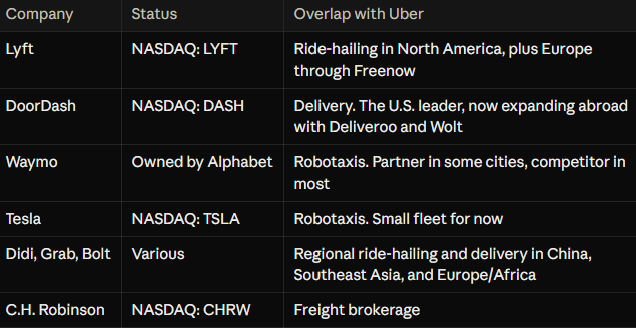
Uber displaced taxis and is clearly winning there, but it faces steep competition elsewhere.
DoorDash’s delivery business is now larger than Uber’s. It dominates US restaurant delivery and is pushing hard internationally, which is why Uber went after Delivery Hero.
On the autonomous side, Waymo does about 500,000 paid rides a week and is targeting 1 million by the end of 2026.
Tesla’s robotaxi network is much smaller and still a work in progress. But if it scales the way Elon envisions, with any Tesla owner able to put their car on the network, that could become a real problem for Uber.
Uber’s Autonomous Vehicle Strategy
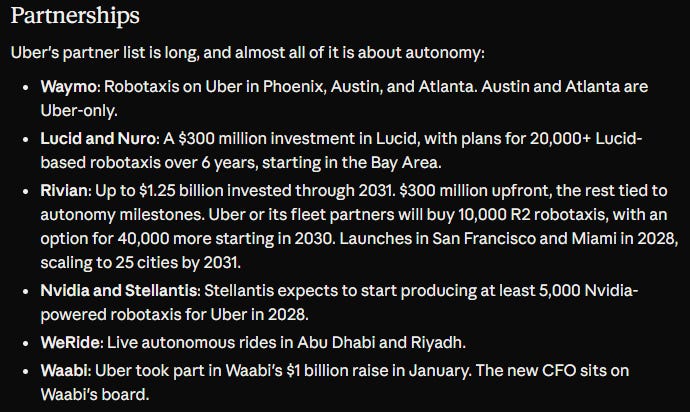
Uber isn’t going to build self-driving cars. It wants to be the network where every self-driving car gets its riders.
Uber shut down its own self-driving program years ago. It’s now partnered with over 20 autonomous vehicle companies across robotaxis, trucking, and delivery robots, and management wants as many partners as possible so it doesn’t depend on any one of them.
The Hybrid Network
Autonomous vehicles can’t handle all conditions yet, and they’re limited to certain areas of each city. So there’s still a need for a hybrid network, where human drivers cover peak demand, bad weather, and areas AVs can’t serve, while AVs pick up what they can.
The CEO has said that in Austin and Atlanta, where Waymo runs on Uber, total trip growth actually sped up after launch. That’s not what you’d expect.
Companies backed by giants like Google or Tesla can build their own apps. But for most AV developers, it’s a better use of resources to pay Uber a fee to be on its network. If that plays out, Uber becomes the marketplace and the middleman.
Locking In Supply
Uber is also locking in AV supply:
Over $1 billion invested in Rivian
$300 million invested in Lucid
Those robotaxis will only run on Uber’s network
Management has mentioned spending roughly $10 billion on these investments over several years, partly with outside financing
Uber clearly sees the potential catastrophe on the horizon and is planning accordingly.
The Rollout
Live with AV partners in 7 cities as of August
Targeting 15 cities by year-end
Los Angeles and San Francisco in 2027
Almost 30 cities globally by 2028
The Open Questions
The strategy is unproven, but Uber is doing its best not to get competed out of existence. Two concerns stand out:
Waymo has its own app. It’s the strongest player in the space and runs its own app in most of the cities where it operates.
Uber hasn’t shared AV economics. We don’t know whether Uber keeps the same cut of a robotaxi fare as it does on a human-driven ride.
I can see why investors are anxious until these strategies play out. I like that Uber has a clear plan, but only time will tell whether it works in Uber’s favor.
Moats
As long as autonomous vehicles don’t take it out, Uber has cemented itself as a leader in its markets:
Network effects: More riders bring more drivers, and more drivers mean shorter wait times. That self-reinforcing loop is hard to displace.
Brand: Uber’s brand is very strong.
Proven Scale: As a market leader printing cash, Uber can make the investments it needs to protect its position.
The big question is whether there’s a clear winner in autonomous vehicles. If it’s Waymo, with its own software, its own app, and a growing customer base across many cities worldwide, that’s a major problem Uber can’t really solve.
Share Buybacks
Given that uncertainty, I’m not a big fan of Uber’s buybacks. The stock is down from its highs, but Uber spent $3.5 billion on buybacks in the first half of 2026 alone, bringing the share count down about 3%.
I’d rather see larger investments in the business right now. That said, Uber is printing money and still growing nicely, so I can’t be too mad about it.
Financials
Q2 2026:
Gross bookings: up 24%
Revenue: up 12%, below consensus estimates
GAAP net income: up 77%
Adjusted EBITDA: up 33% to $2.8 billion
Gross margin: about 45%, up from 40% a year ago
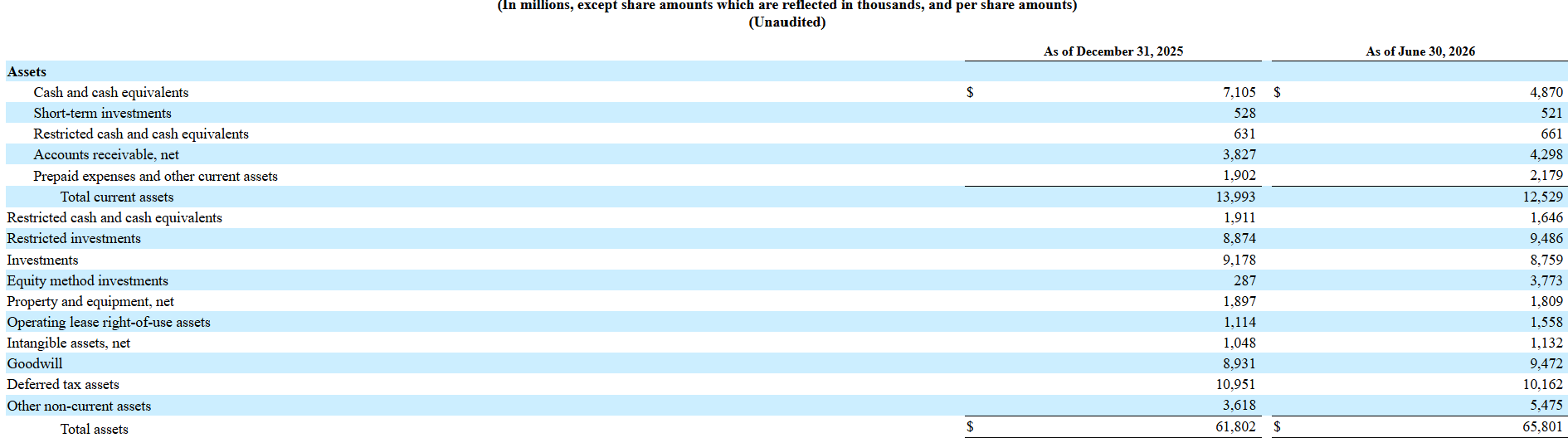
Balance sheet (June 30th):
Cash and short-term investments: $5.4 billion, down from about $7.6 billion at the end of 2025
Total debt: $12.7 billion ($2 billion short-term, $10.7 billion long-term)
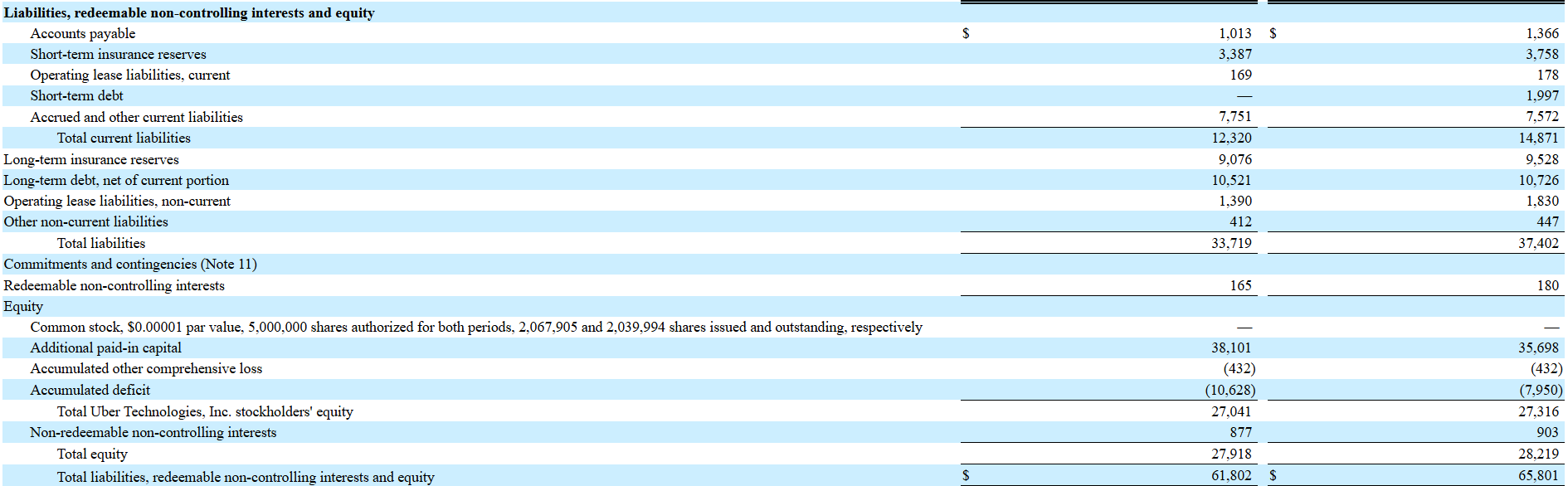
These numbers are from before the Delivery Hero deal. To fund it, Uber lined up:
A €14 billion bridge loan
A $4 billion term loan
A new $7.7 billion credit line
So Uber is taking on a lot of debt for this acquisition, but it should bring a lot of revenue growth in return.
Final Thoughts
Uber’s core business is absolutely killing it:
Bookings growing about 20%
Earnings growing about 30%
$10 billion a year in free cash flow
About 14 times trailing earnings and a 7% free cash flow yield
But there are major risks. It’s hard to know whether Uber’s AV strategy will work, or whether companies like Waymo will build their own customer bases and cut Uber out as the middleman.
If Uber holds its position, I think it has a significant moat. Most of its markets are shaping up as oligopolies with a couple of competitors like Lyft and DoorDash, and there isn’t much competition left beyond that.
So the stock is starting to look attractive, but I’m skeptical about the long term, and honestly, no one knows for sure. For now, I’m going to hold off. I may revisit it in a year or two, once we see how the investments in Rivian and Lucid work out.
Disclaimer
This content is for informational purposes only. You should not construe any such information or other material as legal, tax, investment, financial, or other advice. Nothing contained in this video constitutes a solicitation, recommendation, endorsement, or offer by Investing Review to buy or sell any securities or other financial instruments in any jurisdiction.
All content in this video is information of a general nature and does not address the circumstances of any particular individual or entity. You alone assume the sole responsibility of evaluating the merits and risks associated with the use of any information or other content in this video before making any decisions based on such information.